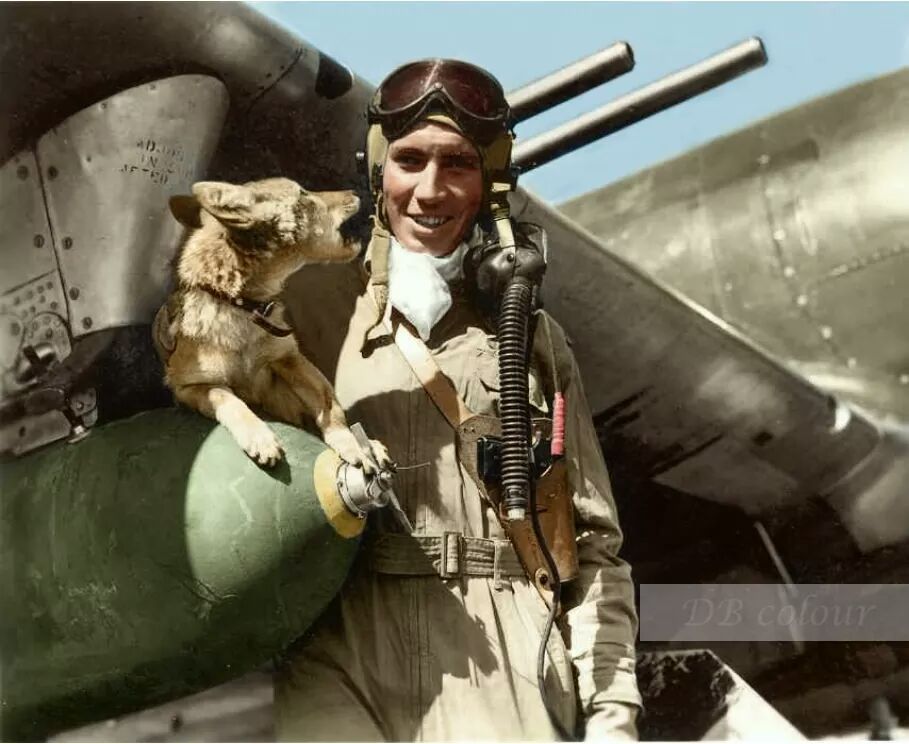
John W. “Wild Bill” Crump and “Jeep” pose for a photo next to Bill’s P-47 Thunderbolt of 360th Squadron, 356th Fighter Group, 8th Air Force. Jeep is laying on a 500 lb bomb.
During the 1930s Depression in America, Bill tried to make a living by helping farmers with their coyote problem. On one occasion a farmer presented Bill with a baby coyote in a box and said he could “start with this one”.
Bill could not find it in himself to kill the animal and adopted it as his pet.
He later smuggled it into the UK when, after earning his wings as a pilot, he was posted to Martlesham Heath. Bill discarded his gas mask and “smuggled” the baby coyote aboard the RMS Queen Elizabeth. The Coyote became a family member at the 360th Squadron, 356th Fighter Group, 8th Air Force.
The coyote had “dog” tags, a log book (“Form 5 ”), Immunization record. The coyote was called “Jeep” NMI Coyote ( NMI stands for “No Middle Initial”), and he accompanied Bill on his missions, in the cockpit of his Thunderbolt, named “Jackie.” Bill later flew P51, Mustangs.
Bill was billeted at Playford Hall during his stay here, and it was at there that “Jeep” sadly died when he was accidentally run over.
Jeep received a Military funeral, “missing man” formation, taps and a victory roll roll by his master, before being laid to rest with a gun salute of Colt 45s, in the grounds of Playford Hall. A plaque marks the spot.
The B-17G just dropping its bombs (in shot) is tail s/n 43-38415 “Smokey Joe” from the 391st BS, 34th BG, 8th AF. This aircraft would go on to fly over 50 missions!
The photographer Lew Funk’s mission log states: 21st February 1945 Nurnberg, Germany. Hitting Marshalling Yards with PFF. “Lots of Flak! Saw red colored flak near battle lines, one bust punctured the ship right beside me (on the opposite side. Pilot Hemmersly, Ship #271, Time 8:25am.”
34th BG records read: 38 planes dispatched. 35 planes dropped 85 tons on the primary target and 2 planes dropped 5 tons on targets of opportunity, while one plane failed to bomb.
66th Fighter Squadron Joe Angelone’s P-47 #71 “Toots”
This picture of “New 71” was taken on Corsica at Alto Air Base 1944. The armament mech’s nick name, “LIL ABNER” is painted on the starboard side. His name was Homer Duchon, and he had a striking resemblance to a well known newspaper cartoon character of that name. He was also a great man to take care of my guns. They always worked to the last round.
Deck crew spot-checking Douglas SBD-5 Dauntless dive bombers of bombing squadron VB-12 on the flight deck of the U.S. Navy aircraft carrier USS Saratoga (CV-3),
OPERATION SHOESTRING 2
After participating in combined fleet exercises off Espiritu Santo between the 7th and 10th of October 1943, VF-12, now part of
Carrier Air Group 12, departed Espiritu Santo aboard the USS Saratoga (CV-3) on October 31,1943; along with Air Group
23 aboard the USS Princeton (CVL-23), to form backbone of Task
Force 38. Here USS Saratoga is underway off Espiritu Santo in October 1943.
As part of Operation Shoestring 2, Task Force 38 was assigned to raid the Japanese airfields on Buka and Bonis Islands off the northern tip of Bougainville, in order to cover the landings being made at Cape Torokina and Empress Augusta Bay. For the first two days in November 1943, the Saratoga, and Princeton made
vicious assaults on the Buka and Bonis Islands airfields, approaching so close to shore (13 miles south east of the islands (06* 25’ S 154* 53’ E) that the twin fields were almost visible from the ships. (www.vbf-12.com)
(U.S. Navy Photograph, U.S. National Archives and Records Administration)
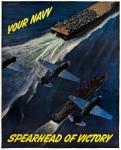
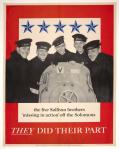
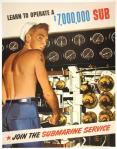
During World War II, the U.S. Navy expanded dramatically. Most were draftees but there were also many volunteers including over 80,000 WAVES (Women Accepted for Volunteer Emergency Service).
To attract volunteers, the Navy operated a publicity office that produced colorful recruitment posters such as the ones seen here from our current exhibit “The Art of War: American Poster Art 1941-1945.”
1st Lieutenant Edwin L. King of the 347th Fighter Squadron (350th FG, 12th AF) stands on the wing of his P-47 ‘Thunderbolt’ at the unit’s home base near Pisa, January 12, 1945.
Lieutenant King and his aircraft found themselves covered in engine oil after a strafing attack on a railroad marshalling yard at Brescia, Italy. During the strafing run the aircraft received a direct hit from a German AA battery which shot up two of the engine’s cylinders.
Notes from Pisa Airfield Tower Log describing the landing:
“10:00 hrs, Midwood Black Leader called for emergency landing and said he didn’t think he could make it. Gold Section led him on to final and tower operator talked him in from there (…) got down and on to taxiway”. Engine and prop completely frozen upon touchdown.
From 347th FS Daily Operations Report #364 of Jan. 12, 1945: Flak damage assessed as Cat. II and no doubt required an engine change along with the clean-up.
This particular aircraft career was to be short lived. Nine days later, on January 21, 1945, another of the squadron’s pilots, Lt. Edward S. Rock, was shot down and killed while flying it.
This and other photos of the same event were taken by Crew Chief H.D. (Henry) Embry who had his camera stolen from him shortly after. As a result he only got to see this now well-known photo many years after the war. Fortunately the thief was kind enough to develop the film…
Original property of Crew Chief H. D. (Henry) Embry